Thursday, 18 February 2016

Biological Magnification

Biological Magnification:

 The increase in the concentration of heavy metals (i.e., mercury) or organic contaminants (i.e., chlorinated hydrocarbons [CHCs])
in organisms as a result of their consumption within a food chain/web. Another term for this is BIOACCUMULATION. An excellent example is the process by which contaminants such as PCBs accumulate or magnify as they move up the food chain. For example, PCBs concentrate in tissue and internal organs, and as big fish eat little fish, they accumulate all the PCBs that have been eaten by everyone below them in the food chain.

DNA

DNA:

  Strand with another pair of nucleotides. The bases are one of five compounds—adenine, guanine, cytosine, thymine, and uracil—that form the genetic code in DNA and RNA.

Bacteria

Bacteria:

One of two prokaryotic (no nucleus) domains, the other being the ARCHAEA. Bacteria are microscopic, simple, single-cell organisms. Some bacteria are harmless or, often, are beneficial to human beings. Others are pathogenic, causing disease and even
death. All play a major role in the cycling of nutrients in ecosystems via AEROBIC and ANAEROBIC decomposition (saprophytic). Some species form symbiotic relationships with other organisms, such as legumes, and help them survive in the environment by fixing atmospheric nitrogen. Many different species exist as single
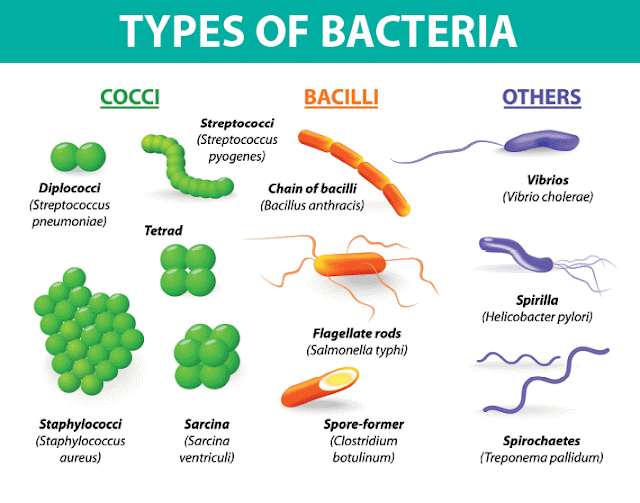
cells or colonies, and they fall into four shapes based on the shape of their rigid cell wall: coccal (spherical), bacillary (rod-shaped), spirochetal (spiral/helical or corkscrew), and vibro (comma-shaped). Bacteria are also classified on the basis of oxygen requirement (aerobic vs. anaerobic).

Atomic Number

Atomic Number:

 The atomic number is equal to the number of positively charged protons in an atom’s nucleus and determines which element an atom is. The atomic number is unique for each element and is designated by a subscript to the left of the elemental symbol.
The atomic number for hydrogen is 1; it has one proton.
Elements are substances made up of atoms with
the same atomic number. Most of the elements are metals
(75 percent), and the others are nonmetals.

Atomic Mass Unit

Atomic Mass Unit

 (amu) One-twelfth of a mass of an atom of the carbon-12 (12C) isotope; a unit used for stating atomic and formula weights; also called a dalton.

Anabolism

Anabolism:

 The processes of METABOLISM that result
in the synthesis of cellular components from precursors
of low molecular weight.

AIDS

AIDS 

(acquired immunodeficiency syndrome) AIDS is
the name given to the late stages of HIV (human
immunodeficiency virus) infection, a disease discovered
and discussed in 1981 in Los Angeles, California. By
1983 the retrovirus responsible for HIV was first
described, and since then millions of adults and children
worldwide have died from contracting the disease. It is
thought to have originated in central Africa from monkeys
or developed from contaminated vaccines used in
the world’s first mass immunization for polio.